
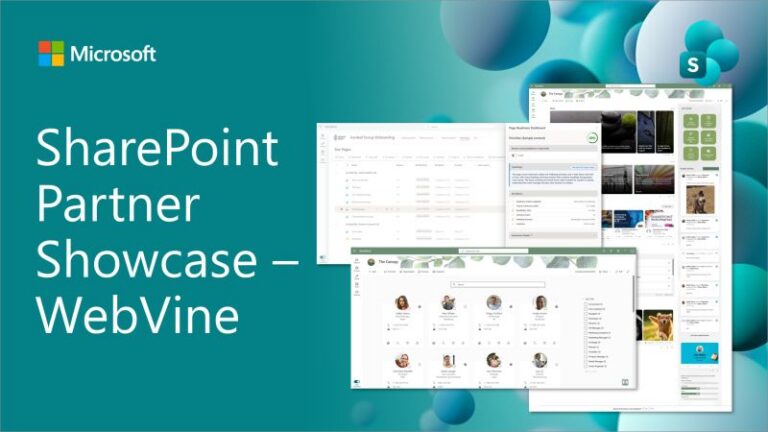
- WebVine was featured on Microsoft’s SharePoint Partner Showcase, highlighting how we build modern digital workplaces on Microsoft 365.
- The showcase focused less on shiny features and more on approach, extending SharePoint sensibly, not replacing it.
- Microsoft called out the polish, clarity, and usability of Injio and Injio Docs, especially how complexity is hidden from everyday users.
- The session explored WebVine’s practical approach to Copilot readiness, starting with content quality and structure before AI.
- We shared how tools like PAT (Page Assessment Tool) and CAT (Copilot Assessment Tool) make readiness visible, measurable, and manageable.
- Being selected for the showcase reinforces WebVine’s long‑standing philosophy: build with the platform, simplify without dumbing down, and design for the long term.
We were proud to be featured by Microsoft in a recent SharePoint Partner Showcase, where Vesa Juvnoen (Microsoft Principal Product Manager) sat down with WebVine to walk through how we design, build and evolve modern digital workplaces on Microsoft 365, including Injio, Injio Docs, and our focus on Copilot readiness.
For us, it was a meaningful moment, because it reinforced how we’ve always chosen to work.
You can watch the full Microsoft showcase video below. If you prefer to read, scroll down to our summary.
Built the way SharePoint is meant to be built
One theme came through clearly during the session: the solutions Microsoft highlights are the ones that extend SharePoint rather than fight it.
That philosophy has guided WebVine since we started working with SharePoint back in 2010.
We don’t build platforms beside Microsoft 365. We don’t replace what works. And we don’t create complexity for the sake of customisation.
Instead, we focus on layering clarity, structure and usability on top of SharePoint’s native capabilities. So, organisations can move faster, with less risk, and without painting themselves into a corner.
Think of it like fitting out a well-designed workspace. You’re not knocking down load‑bearing walls. You’re improving how people use the space every day.
More than products: an approach shaped by people
While Injio and Injio Docs were demonstrated during the showcase, the conversation was really about how WebVine approaches digital workplace problems.
Our team was represented by:
- Chloe Dervin, Managing Director
- James Dellow, Head of Delivery & Product
Between them, they brought together delivery experience, product thinking, and a very practical understanding of what organisations are up against.
We’ve worked with teams who:
- Just want their intranet to make sense
- Are exhausted by fragile workflows and approvals
- Are being asked about Copilot readiness without knowing where to start
That reality shapes every decision we make. From architecture choices through to how much abstraction we add for business users.
“We’re proud Microsoft said this about us”
One of the most affirming parts of the showcase was hearing Microsoft reflect on what they saw during the demo.
A few moments stood out for us.
On Injio’s intranet experience:
“Beautiful looking stuff, super polished.”
On Injio Docs:
“Nice clean implementation, beautiful looking stuff.”
On simplifying complex processes for everyday users:
“The key value here… is the end user doesn’t have to go into Power Automate and understand which step in that complex set‑up they need to modify. Most business users don’t have that skill set. So having that simplification is really nice.”
And on the overall design approach:
“I like the fact that it’s using all the out‑of‑the‑box features and capabilities, but with a simplified layer on top. Adapting it in a more customer‑friendly way.”
For us, those comments mattered because they reflect exactly what we aim for: solutions that feel polished without being heavy, and powerful without being fragile.
Copilot readiness: starting with the fundamentals
The showcase also gave us the chance to talk about an area we’re spending a lot of time on with clients: Copilot readiness.
Not from a “turn it on and hope” perspective. But from a content and structure one.
Why structure still matters (even with AI)
Copilot doesn’t magically fix messy content.
It amplifies what’s already there.
That’s why our approach to Copilot readiness starts with the fundamentals:
- Is content well structured?
- Is it readable by humans?
- Does metadata actually mean something?
During the session, James walked through two tools that support that thinking.
PAT and CAT: making readiness visible and measurable
Page Assessment Tool (PAT)
The Page Assessment Tool (PAT) looks at individual SharePoint pages and scores them against clear, transparent criteria. Things like layout, structure and readability.
It combines:
- Mechanical scoring, to keep results consistent
- Copilot‑assisted feedback, to explain why something scored the way it did
Microsoft described this as a strong, responsible use of AI. Guiding improvement rather than guessing.
It’s the difference between “this page isn’t great” and “here’s what to fix, and why.”
Copilot Assessment Tool (CAT)
The Copilot Assessment Tool (CAT) takes that same logic and applies it at scale.
Instead of reviewing content one page at a time, CAT:
- Scans large sets of intranet and knowledge content
- Groups pages by readiness and priority
- Helps teams focus where effort will make the biggest difference
Microsoft called this out as a great use case for AI: analysing, pre‑checking and presenting information in a way that makes delegation and improvement easier. Not harder.
Supporting readiness
What we were most pleased to see reflected in the conversation was alignment.
Microsoft spoke positively about an approach that:
- Improves content for people first
- Uses AI as an assistant, not a crutch
- Makes quality measurable, visible and manageable
That’s the same approach we take with clients every day.
Copilot readiness isn’t a switch you flip.
It’s something you build towards. One decision, one page, one improvement at a time.
A moment of validation and a signpost forward
Being featured on the SharePoint Partner Showcase was a proud moment for the WebVine team. Its a huge validation of the path we’re already on.
Build with the platform.
Simplify without dumbing down.
Design for the long term.
And help people do their jobs with confidence.
If you’re navigating intranet improvements, document governance, or Copilot readiness and want a practical, human take on what helps, we’re always happy to talk.
Frequently Asked Questions
Why was WebVine featured on Microsoft’s SharePoint Partner Showcase?
Microsoft uses the SharePoint Partner Showcase to highlight partners who build in ways that align with how SharePoint and Microsoft 365 are intended to be used.
WebVine was featured for its practical, sustainable approach to intranets, document management, and Copilot readiness, extending SharePoint rather than fighting it.
What is the SharePoint Partner Showcase?
The SharePoint Partner Showcase is a Microsoft‑run series that highlights real partner solutions and approaches built on SharePoint Online, SharePoint Framework (SPFx), and the Power Platform. It focuses on real‑world implementation, not marketing demos.
How does WebVine approach Copilot readiness differently?
WebVine doesn’t treat Copilot as a switch you turn on.
Our approach starts with the fundamentals:
- Clear structure
- Readable, well‑written content
- Meaningful metadata
Copilot then becomes far more effective, because it’s working with quality inputs.
What are PAT and CAT?
- PAT (Page Assessment Tool) assesses individual SharePoint pages against clear criteria like structure and readability, combining mechanical scoring with Copilot‑assisted feedback.
- CAT (Copilot Assessment Tool) applies the same thinking at scale, scanning large volumes of content to highlight readiness, priorities, and focus areas.
Together, they help organisations move from guessing about readiness to making informed, practical improvements.